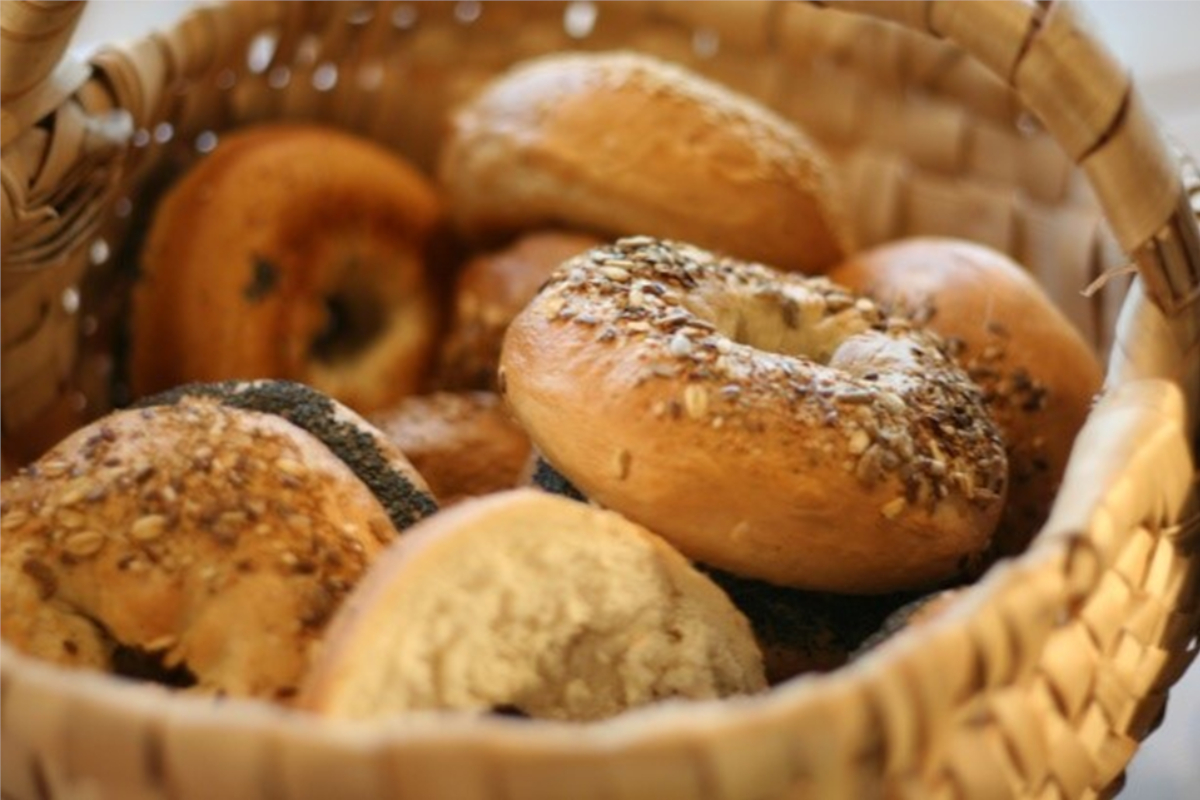
A fresh bagel steams in the hand, its crust glossy and firm, its center dense and pliant. A knife spreads cream cheese thick across its surface, leaving ridges like waves on a smooth sea. Then come the folds of salmon, glistening ribbons that shine with shades of coral and rose. A faint tang of onion fills the air as thin crescents fall into place, tomatoes release their juices in bright red bursts, and capers roll like green pearls across the plate. To eat this is not simply to eat breakfast. It is to taste migration, resilience, invention, and joy in a single bite.
Long before this dish reached American tables, Jewish bakers in Poland had mastered the art of boiling and baking bread into shiny golden rings. Kraków’s records from 1610 describe bagels as gifts for women in childbirth, tokens of nourishment and blessing. Sold on the streets, they swung from wooden poles or dangled on strings around vendors’ necks. Crisp on the outside, chewy at the core, bagels carried symbolism in their circle and strength in their substance.
Jewish immigrants carried those breads to New York at the turn of the 20th century. In the Lower East Side’s crowded streets, the scent of boiling dough drifted before dawn from basement bakeries. Coal-fired ovens glowed in hidden corners, and steam rose from kettles where bagels swelled before baking. Workers bought them on the way to garment shops, children clutched them in paper wrappers, and families filled baskets with them for Sabbath tables. By 1907, bagel makers had formed Local 338 of the Bagel Bakers’ Union, a guild that controlled recipes, wages, and tradition so tightly that for decades nearly every bagel in New York was shaped by one of its members.
If the bagel formed the sturdy foundation, lox brought elegance. Salt-cured salmon descended from centuries of Jewish reliance on preserved fish. Herring had been the Old World staple, a fish cheap and plentiful in the markets of Eastern Europe, eaten pickled, salted, or smoked in every conceivable form. In America, salmon became the fish of choice. Its flesh was larger, firmer, and brighter, carrying a rich pink-orange glow that felt celebratory while being more plentiful. Lox was practical, preserved through a heavy salt cure that required no refrigeration in the years before iceboxes were common. For Sabbath mornings or Sunday brunch, it carried a taste of abundance and refinement.
The word “lox” carries a deep lineage. It descends from the Yiddish “laks,” which itself comes from Old High German and even older Indo-European roots meaning salmon. Cognates still exist in languages across northern Europe. When Jewish immigrants said “lox,” they were speaking a word that had traveled across continents and centuries.
Behind glass counters in the delis of the 20th century, slabs of salmon gleamed under electric light, thick with brine and sliced with long, practiced strokes until the fish lay in translucent ribbons. Customers leaned in, pointing to pieces with more fat for richness or leaner cuts for a drier bite. The air smelled faintly of smoke and sea, mingled with onions, pickles, and tubs of cream cheese waiting beside it.
Not all lox was the same. Traditional lox was salt-cured only, dense and intensely briny. Nova lox, which became popular later, was cured more gently and cold-smoked, producing a milder flavor and buttery texture. Scandinavian gravlax, cured with sugar, salt, and dill, offered a fragrant, slightly sweet variation. Purists debated the merits of each style, but all shared the same silky mouthfeel that made them ideal companions for a warm bagel.
The preservation of lox was more than practical. Salt toughened the fish, just as hardship had toughened immigrant communities. Each slice carried echoes of shtetls left behind and new lives being built in a strange land. Families who could not afford meat for every meal could still gather around a modest plate of lox, stretching thin slices across bagels to make plenty from little.
By the 1930s and 1940s, lox had become shorthand for Jewish-American culture itself. A bagel without lox was like a Sabbath without candles, incomplete. Advertisements for cream cheese in the 1950s capitalized on this, showing glossy photos of bagels draped with salmon and crowned with capers. The dish became aspirational, not just nourishment but an emblem of belonging, of refinement, of having arrived in America while still holding onto Jewish roots.
Cream cheese was the element that transformed the pairing into something unmistakably American. In 1872, William Lawrence of Chester, New York, attempted to replicate a French Neufchâtel. His result was richer, smoother, and creamier. Packaged under the “Philadelphia” brand by the 1880s, it soon filled grocery shelves across the East Coast. Advertisements promoted it as refined and modern, a food that could lift the simplest bread into elegance.
Jewish immigrants discovered cream cheese as they searched for kosher dairy products to accompany bagels and fish. Thick, smooth, and slightly tangy, it became ideal for spreading on bagels. Its mild flavor balanced the salt of lox and the sharpness of onions, while its smooth texture softened the chew of the bread. Thick blocks of cream cheese were sliced at delis and appetizing stores, sometimes wrapped in wax paper, sometimes served in neat wedges with knives ready to carve. The Yiddish word “schmear,” meaning spread, became shorthand for the ritual act. To schmear a bagel was to give it life.
Appetizing stores, distinct from Jewish delicatessens, specialized in dairy and fish rather than meat. They emerged alongside delis in New York’s Jewish neighborhoods, offering cream cheese, smoked fish, herring, olives, pickles, and salads. Inside, glass cases glowed with salmon, whitefish, and tubs of cream cheese blended with scallions or vegetables. The hum of conversation and the scent of brine and smoke filled the air. Customers ordered bagels with “a schmear and lox,” and clerks wielded long knives to slice salmon so thin it nearly floated. The pairing became both a delicacy and a weekly ritual.
By the 1930s, the trio of bagel, lox, and cream cheese was firmly cemented in Jewish American life. Sunday mornings centered around it. Paper bags of warm bagels sat beside platters of lox arranged like satin ribbons. Cream cheese softened in dishes, waiting for knives to scrape and spread. Capers sparkled like tiny jewels, onions released their perfume, and tomatoes bled into the bread. Around these tables families laughed, debated, and lingered, sustaining body and spirit alike.
Postwar years carried the tradition outward. As Jewish families moved into Brooklyn neighborhoods, Long Island towns, and suburban streets, appetizing stores and delis followed. Cream cheese brands advertised bagels and lox in glossy magazines, presenting them as cosmopolitan brunch for the upwardly mobile. By the 1960s, bagels were being mass-produced, and cream cheese had become an American staple. Yet in Jewish homes, the ritual held onto its sacredness. A bagel without a schmear was no bagel at all.
Today, the ritual lives on, though often disguised in convenience. Supermarkets carry pre-sliced bagels and tubs of flavored cream cheese. Chains package sandwiches for hurried commuters. Yet the truest version still thrives in small bakeries and old-style appetizing stores. A bagel pulled hot from the oven, cream cheese spread in thick ridges, salmon sliced so thin light shines through it, onions translucent and cool, tomatoes bright with summer juice, capers bursting with salt. Each bite recalls Kraków markets, Lower East Side tenements, Scandinavian curing traditions, and New York dairies.
What seems like a simple plate is in fact an edible archive. Bagels and lox with cream cheese are migration turned into comfort, invention turned into tradition, survival turned into joy. To eat them is to honor generations who carried bread across oceans, adapted fish to new waters, and embraced cream cheese as their own. The chew of the bagel, the silk of the salmon, the tang of the schmear, and the bite of the onion all blend into a harmony of history that refuses to fade.