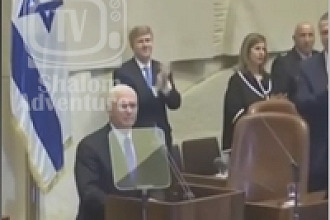
It is an assembly of 120 parliamentary members named as such after the rabbinical legislative body that ruled over Judea 2,000 years ago.
Israel became an independent state in 1948; however, the first meeting of Parliament’s Constituent Assembly (Ha’asefah Hamekhonenet) occurred 14 February 1949 in Jerusalem after the nation’s first general election on January 25. The first goal of the new assembly was to literally construct a more permanent concept of the Knesset (versus an unofficial meeting of various individuals) and grant itself the abilities to elect a president for the State of Israel.
Parliamentary meetings of the Knesset were originally held at the Tel Aviv Museum, then later temporarily convened at Beit Frumin on King George V Street in Jerusalem which was originally infratructure intended for banking operations while other plans were underway for building another government complex near Givat Ram in southern Jerusalem.
Knesset members claimed the land on the southern slope of a hill in 1955 for the precise building of their new government complex, explaining that there had been Jewish settlements and burial caves on the site dating back to the Second Temple period. Contruction was completed nearly a decade later. As of 31 August 1966, the Knesset now permanently meets at Kiryat Ben Gurion, land technically owned by the Greek Orthodox Church.
The Greek Orthodox Church, the second largest landowner in Israel, Jerusalem, and the West Bank after the Israel Lands Authority (aka the government), has a longstanding policy of not selling land to anyone, but is open to negotiating long term leases. In the case of the Knesset (parliament) and the Kiryat Hamemshala (area designated for government offices), the Greek Orthodox church signed a 99 year lease with Israel in 1952 with options for renewal and renegotiation after 49 years.
Unlike American politics where voters elect representatives from their areas to represent their voice in Washington (representative democracy), winning a seat in the Knesset operates by proporational representation of various groups in Israel (parliamentary democracy). There are no districts or precincts, but rather, the entire State of Israel is one large precinct. Elections occur at least once every four years, often more frequently, and each political party issues a list of candidates eligible for Knesset seats.
The number of names that may be selected is dependent on the proportional representation of votes for the party, and any party winning at least two percent of the overall vote is allotted at least two Knesset seats. Israelis do not directly vote for the leaders of the executive branch of their government; however, such decisions on who to lead the country in presidential and prime minister roles emerge from the Knesset.