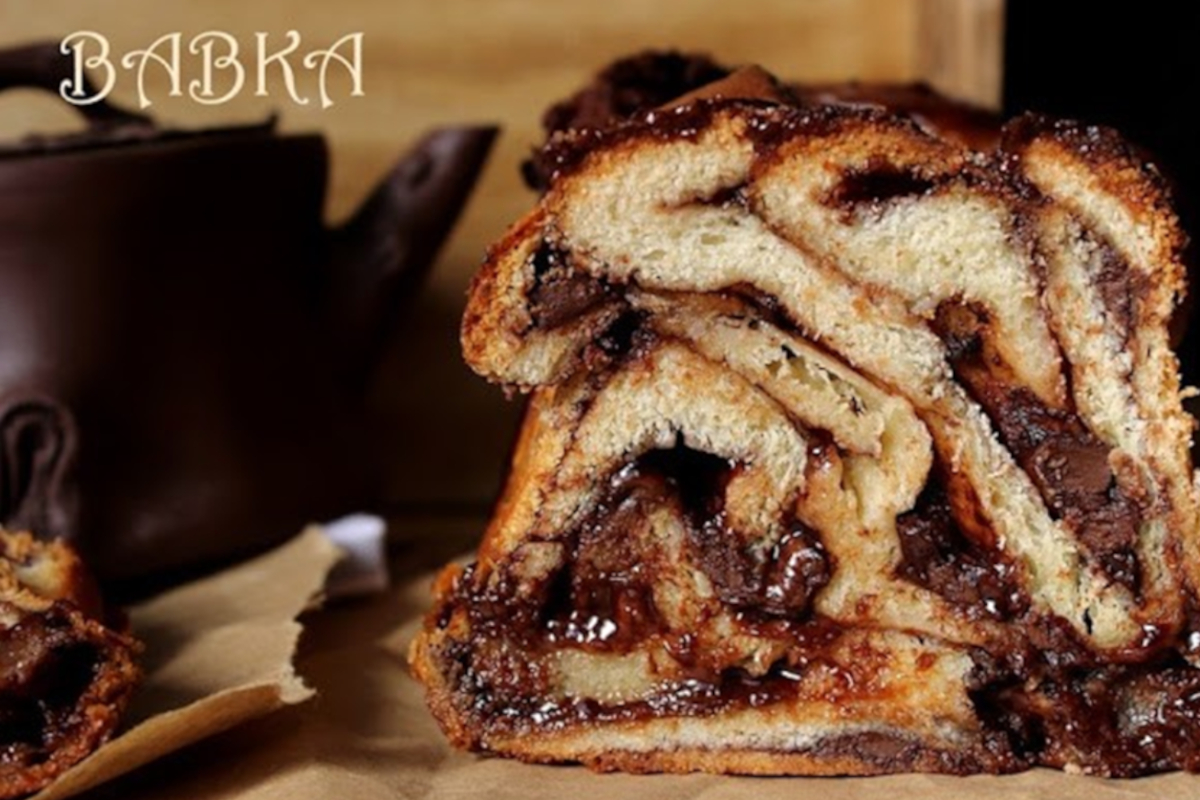
The smell of babka fills a kitchen with sweet yeast, melted chocolate, and cinnamon, instantly evoking warmth, home, and tradition. Golden-brown crusts crackle lightly under the knife, revealing soft layers twisted with ribbons of filling. Each swirl carries the care of generations. More than a pastry, babka is a story baked into dough, a taste of family, memory, and culture, connecting the present to Jewish households in Poland and Ukraine where grandmothers first shaped and shared these loaves.
While historical records are limited, oral histories support this connection. These loaves were cherished in Jewish communities, though similar sweet breads existed more broadly in Eastern Europe, and their popularity later spread beyond Jewish households, particularly in mid-20th-century New York, eventually reaching wider audiences through popular culture.
Tracing its roots back to the late 19th or early 20th century, babka carries the name meaning grandmother in Polish, reflecting the central role these women played in family life. Some sources suggest the name may also be inspired by the loaf’s shape resembling a woman’s skirt, but this is largely folkloric and not definitively proven; the most accepted explanation is that it is simply an affectionate term for grandmother. Grandmothers were often the bakers, guiding little hands in the kneading, folding, and twisting of dough. They preserved recipes passed down through generations, adding their own touches and creating loaves that were as much about love and memory as they were about taste.
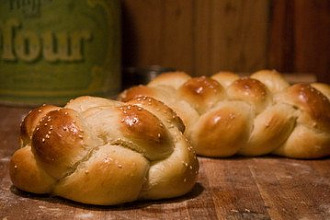
Babka was baked for Sabbath mornings, festive meals, and family gatherings, with every swirl and twist carrying care and intention. Early versions were simple, often flavored with cinnamon, raisins, nuts, or poppy seeds, braided or twisted into tall loaf pans. Some historians propose that Jewish babka may have originally been made from leftover challah dough, though this is speculative. The design was decorative but also a reflection of the grandmother’s artistry and devotion. This is distinct from the Polish Easter babka, or baba, which is a taller, round, fluted cake, often flavored with dried fruits and rum. That version is different from the braided, loaf-shaped Jewish babka that became popular through the Jewish diaspora.
Emerging from earlier Eastern European sweet breads, babka reflects a rich tradition of yeasted cakes and breads found across the region. It may have been influenced by European loaves such as kugelhopf, though historical evidence is limited. What is clear is that Jewish bakers adapted these ideas to create something uniquely their own. Emphasizing sweet fillings and a braided form, they transformed these breads into a distinct household treat, weaving care and artistry into every loaf.
Across different regions, variations emerged. In Poland, cinnamon and sugar swirls were most common, while Ukrainian families often incorporated poppy seeds, a widely used ingredient across Central and Eastern Europe, prized for flavor and symbolism. While these flavors were common in certain regions, families often adapted recipes based on taste and available ingredients. These regional differences reflect local tastes and available ingredients, with cinnamon prevalent in Poland and poppy seeds common in Ukraine. In some communities, fruit preserves, nuts, or honey enriched the dough, reflecting local tastes and availability. These regional differences gave each community its own signature version of babka, while the overall braided or twisted structure remained a unifying characteristic.
Waves of Jewish migration in the late 19th and early 20th centuries brought babka to the United States. Families fleeing persecution, pogroms, and economic hardship recreated their recipes in new kitchens. In New York City, cocoa became more widely available, giving rise to chocolate babka, likely in the 1950s–60s rather than immediately upon immigration. Over time, the dough was enriched with more butter and sugar, and the chocolate and other fillings became more generous and decadent, creating a richer, more luxurious loaf. Traditional Jewish babka often used oil instead of butter to remain parve and kosher, though modern versions sometimes use buttery, brioche-style dough for a softer, richer texture.
Babka’s adaptability has allowed it to cross cultural boundaries. In times of scarcity, families improvised with apples, nuts, or poppy seeds. Modern bakers experiment with Nutella, cream cheese, or even savory fillings such as cheese and herbs, bringing babka into cafés and artisan bakeries around the world. In Israel, a distinctive version known as ugat shmarim has emerged, often featuring laminated, buttery dough similar to croissant and inspired by European Jewish babka, though it is not identical to traditional New York–style Jewish babka. Despite this mainstream popularity, the loaf retains its roots as a homemade treat for Sabbath and celebratory meals, bridging the gap between its Jewish heritage and global appeal.
Cultural pride and culinary creativity have kept babka evolving. Some families maintain traditional recipes passed down for generations, while others embrace contemporary flavors and shapes. Specialty bakeries often honor both approaches, offering classic cinnamon and chocolate swirls alongside inventive combinations that reflect today’s palate. Whether simple or rich, every loaf connects to history, migration, and the warmth of shared meals.
In recent years, babka has experienced a renaissance on a global scale. Instagram feeds and food blogs have introduced this braided loaf to audiences far beyond Jewish communities. Cafés from Tel Aviv to London, Paris, and Los Angeles feature babka in display cases alongside croissants and sourdough, sometimes reimagined with trendy flavors such as matcha, salted caramel, or seasonal fruit. Food enthusiasts celebrate its swirls and layers as much as its taste, making babka not only a symbol of tradition but also a canvas for modern culinary artistry. This widespread popularity has helped preserve interest in the classic recipes while inspiring new generations to explore both traditional and inventive versions.
Representing resilience, culture, and connection, babka’s soft, buttery layers and sweet swirls invite sharing, storytelling, and memory. Each loaf carries a story of families, migration, and adaptation, reminding us that some traditions endure not only because of their history but because they continue to delight people across generations and communities. Babka is a reminder that some traditions are worth keeping, preserved in flavor, care, and the simple joy of breaking bread together.