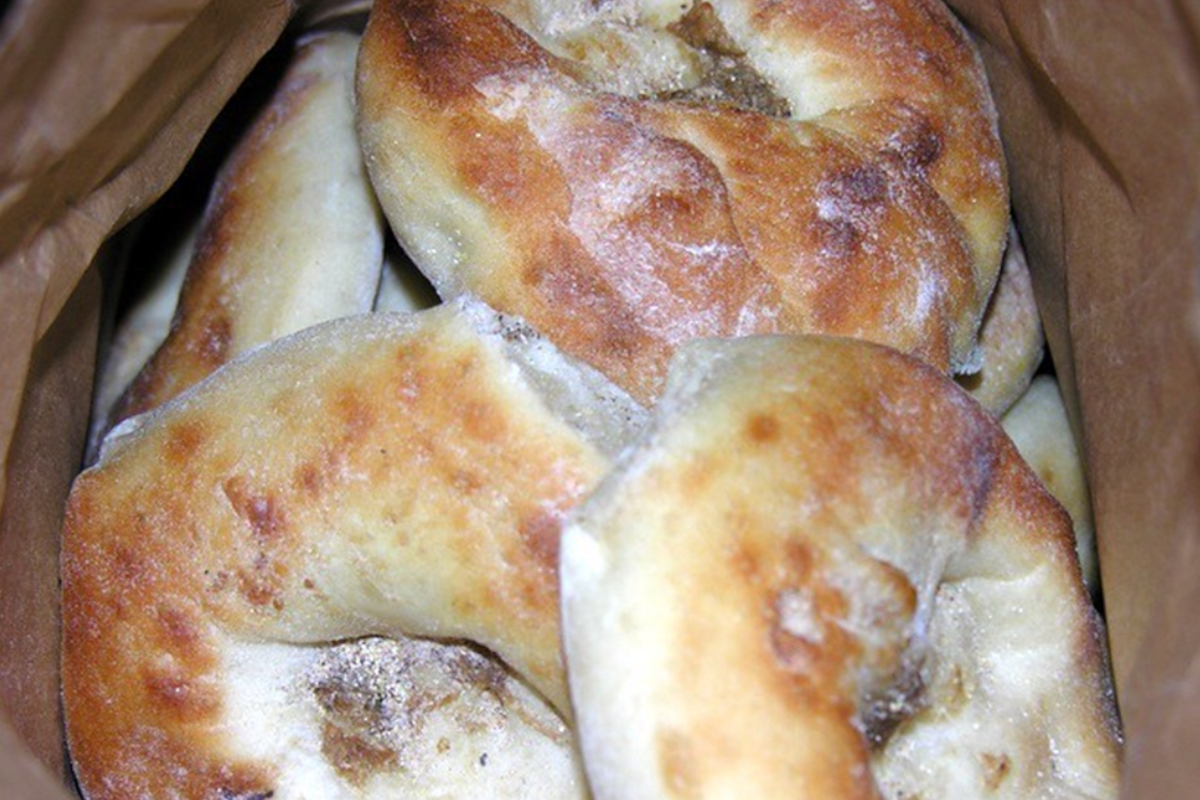
Bialys emerge from the oven with a warm, golden crust, sometimes lightly dusted with flour. A shallow depression in the center holds caramelized onions and poppy seeds, releasing a rich aroma of sweetness and earthiness. The edges are tender rather than hard, giving way to a soft, chewy interior, and biting into one reveals bread that yields pleasantly under pressure. Caramelized onions fill the mouth with gentle sweetness while poppy seeds add a subtle earthy crunch. The dough carries a mild fermentation note, balancing the richness of the topping. Scents of roasted onions and nutty seeds drift upward, filling kitchens with warmth, nostalgia, and comfort.
Originating in Bialystok, a city in what is now northeastern Poland, bialys became a staple of 19th-century Ashkenazi Jewish life. Baked in wood-fired ovens and sold at local bakeries, these flat, round breads with onion-filled centers stood apart from the ring-shaped, boiled bagels of the region. Bagels have dense, shiny, and uniformly chewy interiors, while bialys feature thinner crusts, softer crumbs, and open centers designed to hold concentrated flavor. Toppings differ as well: sesame seeds or poppy seeds often coat the exterior of bagels, but bialys incorporate theirs into the heart of the bread. Each bite delivers a concentrated burst of taste rather than a uniform chew.
Textural differences enhance the contrast. Bialys are lightly chewy and slightly airy, inviting a gentle bite that reveals sweetness and subtle crunch. Bagels, boiled before baking, remain denser and more substantial, requiring a longer chew. Bagels lend themselves to slicing and filling, creating versatile sandwiches, whereas bialys offer a more intimate experience, rustic and immediately flavorful.
Jewish immigrants brought bialys to the United States in the late 19th and early 20th centuries, preserving regional traditions in kitchens and bakeries. They became treasured for their authenticity and their connection to Eastern European Jewish life. Mornings and Sabbath meals carried the aroma of fresh bialys, evoking family, community, and memory. Each one offered a taste of home, linking generations through a shared culinary heritage.
Bialys occupy a unique place in Jewish culture. While bagels evolved into a global symbol of Jewish cuisine, often adapted far beyond their origins, bialys remained a quieter emblem of heritage. Open centers and soft crusts reflect the bakeries of Białystok, the journeys of immigrants, and daily rhythms that valued flavor, practicality, and care. Every bite carries history and tradition, connecting the present with the kitchens and families of the past.