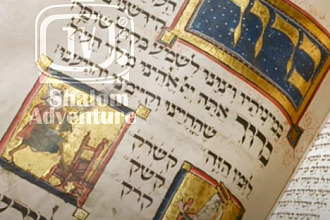
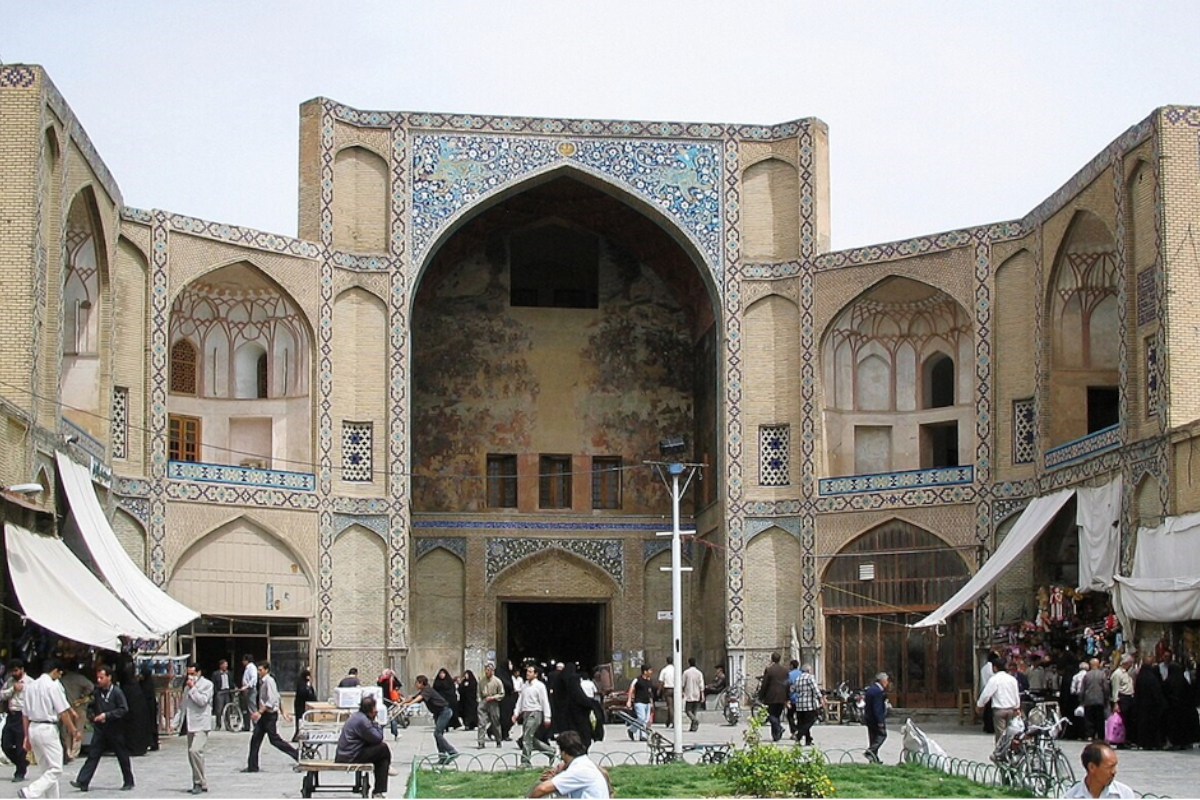
Imagine wandering into a bazaar in medieval Isfahan. Merchants call out prices in Persian, their voices weaving through the scent of spices and the chatter of passersby. Poets recite verses that drift like perfume, and tucked into the corner of a synagogue, a scribe leans over a manuscript. The words sound like the Persian outside but on the page they look entirely different. Curves and dots, the familiar strokes of Hebrew letters, march across the parchment. This is Judeo-Persian, a written form of the Persian language used by Jewish communities, combining Persian vocabulary with Hebrew script.
For centuries, Jewish communities in Iran lived alongside Persian culture while keeping their own traditions. They spoke the same tongue as their neighbors yet when they wrote it, they used Hebrew letters. It was Persian, but written in a distinctly Jewish form. The language absorbed layers of Jewish memory, biblical references, and religious vocabulary, creating something both familiar and uniquely its own.
Jewish life in Persia stretches back to the Babylonian exile. Cyrus the Great allowed Jews to return to Jerusalem or remain in their settlements. Many stayed, weaving themselves into Persian society while preserving Hebrew for prayer. By the early Islamic centuries, as Persian poetry and literature blossomed, Jewish voices joined the chorus. Their writing, however, followed a different path: Hebrew letters capturing Persian sounds, marking them as insiders and outsiders all at once.
Judeo-Persian writing is full of echoes. It mirrors the grandeur of Persian epics, carries the cadences of the Qur’an, and hums with the rhythms of the Hebrew Bible. Some of the earliest works retold biblical stories in Persian verse, giving them the heroic sweep of Ferdowsi’s Shahnameh, the national epic of Persia that chronicles the legendary and historical past of the Iranian people through poetry. While surviving Judeo-Persian epics are fewer and less widely known than Persian literary epics, they sometimes cast Esther, Mordecai, and Daniel in the style of Persian kings and warriors, speaking in rhymed couplets embroidered with Jewish faith and Persian imagery.
These poems were more than entertainment. They were survival. Heritage cast in the style of the surrounding culture became a shield. To a Jewish listener in Shiraz or Kashan, the verses sounded both familiar and protective: We are part of this world, yet we remain ourselves.
Not all Judeo-Persian was lofty. Many manuscripts are practical: letters between merchants, notations in prayer books, legal documents, even instructions for dyeing cloth. One father frets over arranging a dowry for his daughter. Traders debate the dangers of desert caravans. Scribbled in Hebrew characters, these texts offer windows into Jewish daily life in Iran, where religion, family, and commerce were woven tightly together.
Using Hebrew letters acted as a kind of shield. It kept Jewish correspondence semi-private even as the language remained Persian. A Muslim passerby might understand the words when spoken but be unable to read them on the page. Writing this way created both intimacy and protection.
Over the centuries, Judeo-Persian shifted with the tides of history. Dynasties rose and fell, Jewish communities moved, adapted, and sometimes suffered exile or forced conversion. Their language evolved alongside these changes. By the 19th and 20th centuries, many Jews in Iran spoke dialects of Persian mixed with Hebrew words, while educated scribes kept alive the older written tradition.
The 20th century scattered Iran’s Jews across the world, from Tehran to Tel Aviv, from Shiraz to Los Angeles. With migration came loss, as younger generations often left Judeo-Persian behind in favor of Hebrew, English, or modern Persian. Yet traces survive. Elderly Iranian Jews still recite snippets of verse. Family prayer books carry marginal notes in Hebrew letters. Scholars carefully preserve and translate the old manuscripts.
Judeo-Persian is not just a relic. Identity can be layered, not divided. A Jew in Isfahan could pray in Hebrew, trade in Persian, and write in a hybrid form that carried both. It is a language born of adaptation, resilience, and creativity, a way of surviving empire after empire without losing the thread of belonging.