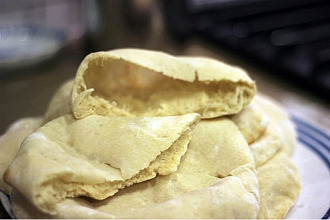
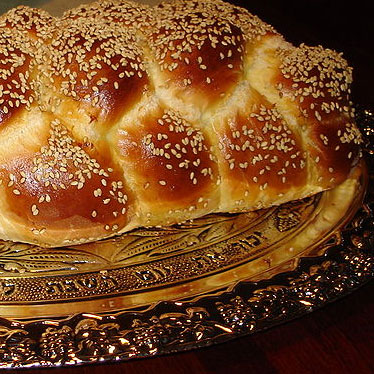
 Any traditional Jewish meal begins with the breaking of bread. Challah is a special kind of bread used for Shabbat and holidays. It is a very sweet, golden, eggy bread. The taste and texture is somewhat similar to egg twist rolls (those little yellow rolls that look like knots). The loaf is usually braided, but on certain holidays it may be made in other shapes. For example, on Rosh Hashanah, it is traditional to serve round challah (the circle symbolizing the cycle of life, the cycle of the years).
A local deli makes French toast with challah. I highly recommend this. Challah is also wonderful in sandwiches with roast beef or corned beef. Traditionally, however, it is simply used as you might use rolls with a holiday dinner.
The word "challah" refers to the portion of dough set aside for the kohein (See the List of Mitzvot, #394); that is, a portion that is taken out of the dough before it is baked. You may have seen the notation "Challah has been taken" on boxes of Passover matzah, indicating that this rule has been followed, that the challah portion was taken from the dough before the matzah was made. I am not certain how the term for the removed portion came to be used for the loaf of bread made after that portion has been removed.
Bagels and Lox
Is there anybody who doesn't know what a bagel is? A bagel is a donut-shaped piece of bread that is boiled before it is baked. They are often topped with poppy seeds or sesame seeds, or flavored with other ingredients. The bagel has been a part of Jewish cuisine for at least 400 years. According to Leo Rosten's The Joys of Yiddish, there are references to it as far back as Poland in 1610. In America, bagels are traditionally served with cream cheese and lox (smoked salmon) or other fish spreads (herring, whitefish, etc.). They are also quite good with cream cheese and a thick slice of tomato.
Those chewy hockey pucks that you find in your grocer's freezer bear little resemblance to a real bagel. A real bagel is soft, warm and spongy inside, lightly crispy outside. A fresh bagel does not need to be toasted, and should not be. Toasting is a sorry attempt to compensate for a sub-standard bagel.
Written by: Judaism 101
Originally from here
Posted on ShalomAdventure.com by: Brenda Miller
Picture by: Aviv Hod